
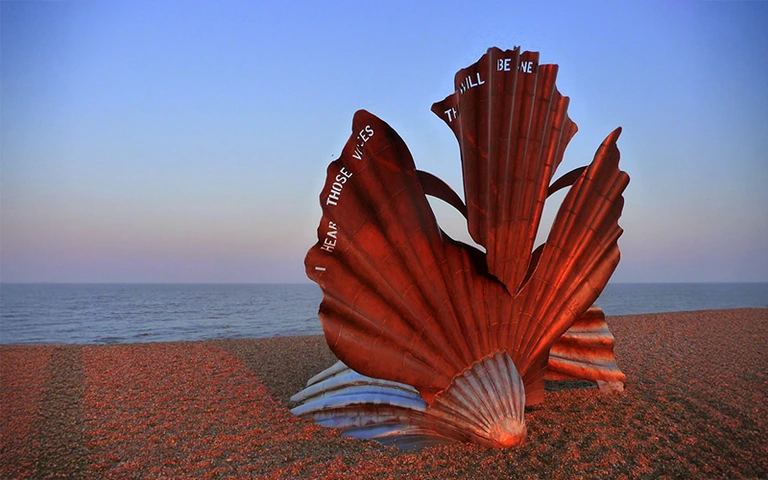
Standing on the windswept shingle of Aldeburgh Beach in Suffolk, England, Maggi Hambling’s Scallop is a striking and divisive piece of public art. Installed in 2003, the four metre high stainless steel sculpture was created as a tribute to Benjamin Britten, the composer who lived in Aldeburgh and whose music was shaped by the sound and mood of the North Sea.
The sculpture’s design features two interlocking steel shells, one standing tall and jagged, the other set within it, giving the impression of a scallop opened by the force of the sea. Cut into the steel are the words “I hear those voices that will not be drowned,” a line from Britten’s opera Peter Grimes. The text is not hidden away. It is part of the structure itself, allowing light to pass through the letters and casting shadows across the shingle depending on the time of day.
Up close, the surface shows the texture of weathered steel. From a distance, the outline is sharp against the horizon. The choice of stainless steel was deliberate. It resists corrosion from salt air and shifting tides, and it reflects the changing Suffolk sky. In bright sun it can appear almost luminous. Under grey cloud it looks darker and heavier. The sea and the sculpture are in constant visual conversation.
Benjamin Britten lived and worked in Aldeburgh for many years and co founded the Aldeburgh Festival. His opera Peter Grimes, with its strong themes of isolation, community pressure and the power of the sea, is closely associated with this stretch of coastline. The line carved into the steel speaks to that connection. It anchors the sculpture in local history rather than presenting it as an abstract object placed at random.
For Suffolk, the link matters. Britten is one of the county’s most internationally recognised cultural figures. Positioning the sculpture directly on the beach, rather than in a park or formal setting, reinforces the idea that the landscape itself influenced his work. Visitors do not view the artwork in isolation. They experience it with the wind, the sound of waves and the wide open horizon in front of them.
Since its installation, Scallop has sparked both admiration and controversy. Some see it as a powerful and fitting tribute to Britten, sitting comfortably within the vast, open setting of the Suffolk coast. Others argue that its industrial form contrasts too sharply with the natural surroundings. Over the years, it has been targeted by vandalism, with graffiti appearing on its surface from time to time. That response, positive or negative, reflects the strength of feeling it generates.
Public art often divides opinion, and this piece is no exception. What cannot be denied is that it has become part of Aldeburgh’s identity. It appears in photographs, guidebooks and social media posts. Walkers use it as a landmark along the shingle. For some residents it represents creative confidence. For others it remains contentious. Either way, it is firmly embedded in the story of the town.
Despite the debate, Scallop has become an established landmark, drawing visitors from across the country. It is freely accessible on Aldeburgh Beach and can be reached on foot from the town centre. There are no barriers or formal viewing platforms. The sculpture sits directly on the shingle, exposed to the elements, which is part of its impact.
Conditions change the experience. On calm days it feels contemplative, with the sea stretching quietly beyond. In stronger winds the setting becomes more dramatic, and the scale of the structure feels more pronounced. Many visitors pause to read the inscription, take photographs or simply look out to sea through the cut out letters.
For those walking along Aldeburgh Beach, Scallop offers a clear focal point. As the waves break and the sky shifts above the North Sea, Hambling’s tribute remains fixed in place. It is bold, deliberate and unmistakable, a modern addition to a historic coastline that continues to prompt conversation.

© 2026 Rum Owd Dew Made by WebDAC