
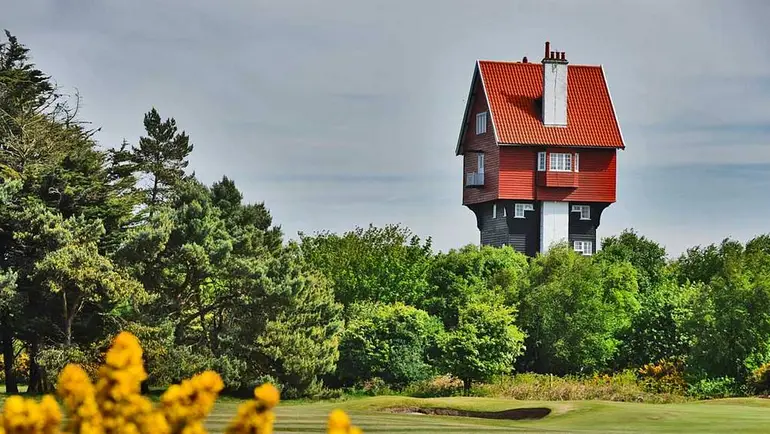
Nestled in the charming coastal village of Thorpeness, Suffolk, stands one of England’s most whimsical and unique architectural wonders, The House in the Clouds. A beloved local landmark, this curious structure, which appears to float above the treetops, has captivated visitors and residents alike for over a century. But what exactly is the story behind this enchanting house?
To understand it properly, you have to understand Thorpeness itself. This was never an ordinary seaside village that simply grew over time. In the early twentieth century it was shaped and guided by one man’s vision. The aim was to create a carefully designed holiday retreat, something peaceful, imaginative and slightly different from the typical British resort. The House in the Clouds was part of that wider plan, not an accident and not a gimmick, but a practical solution wrapped in creativity.
Originally built in 1923, The House in the Clouds was designed to conceal an otherwise unsightly water tower. As part of Glencairn Stuart Ogilvie’s vision to transform Thorpeness into an idyllic holiday retreat, the village’s infrastructure needed a water supply solution. Rather than settling for a plain industrial tower, the designers cleverly disguised it as a charming country house, giving it the fairytale appearance it retains today.
The tank at the top held around 30,000 gallons of water and served the village for decades. From ground level you would never know its true purpose. Timber framing, painted render, windows and a pitched roof all helped sell the illusion. It was engineering hidden inside architecture, which is perhaps why it still feels clever rather than novelty.
At around 70 feet tall, it was never subtle. It rises well above the surrounding trees and can be seen from various points around the village and nearby golf course. That visibility is part of its charm. It was built to be useful, yet it became a landmark almost immediately.
By the 1970s the original water system had become outdated. In 1977 the tank was removed and the structure was converted into a private residence. What could easily have been demolished instead found a second life. The internal layout was adapted to create multiple floors of living space, turning a piece of infrastructure into somewhere people could actually stay.
Today it operates as a holiday home. It includes five bedrooms spread across several levels, along with living areas and a top floor space where the tank once stood. From the upper windows the views stretch across Thorpeness, the Meare and out towards the Suffolk coastline. On a clear day you can see how carefully the village was laid out, with its mix of cottages, open greens and water.
The staircase linking each floor is part of the experience. You move vertically through the building in a way that feels very different from a conventional house. It reminds you that this was once a working tower. The character comes from that unusual origin.
Inside, The House in the Clouds offers five floors of living space, featuring five bedrooms, a lounge, a dining area and wide views from the top. Each level has its own feel. Lower floors feel more grounded and traditional. Higher floors feel lighter and more open, helped by the elevated position above the trees.
What many people do not realise is that the house was never intended to be symmetrical or grand in the way large country houses are. Its proportions were dictated by the tank it had to hide. That constraint is what makes it interesting. It is a reminder that good design often starts with solving a problem.
Whether you are staying overnight or simply passing through Suffolk, The House in the Clouds is a must-see attraction. Situated near Thorpeness Meare, a man-made boating lake inspired by J.M. Barrie’s Peter Pan, the house complements the whimsical spirit of the village.
Locally, it has become more than a building. It is part of Thorpeness’s identity. It appears on postcards, guidebooks and countless holiday photographs. For many people it is the first thing they look for when arriving in the village. It acts as a reference point. If you can see the House in the Clouds, you know roughly where you are.
There are also a few details that are easy to miss. From certain angles the structure genuinely seems detached from the ground, especially when morning mist hangs low over the common. The original purpose as a water tower is not obvious unless someone tells you. And while it looks old and almost medieval in style, it is firmly a twentieth century creation.
For visitors, the basics are simple. You can view it clearly from Thorpeness Common and from nearby public paths. If you want to stay inside, it operates as a bookable holiday property and can be reserved in advance. Even if you do not step inside, a walk around the village gives you plenty of vantage points to appreciate it properly.
Today, it remains a symbol of creativity and ingenuity, proving that practical solutions need not sacrifice beauty and charm. It represents a moment in Suffolk’s history when imagination shaped the built environment. If you ever find yourself in Thorpeness, take a moment to look up at this floating fairytale home. It has been watching over the village for more than a hundred years, and it is still doing the job it was built for, even if that job has changed.
Have you ever visited The House in the Clouds?

© 2026 Rum Owd Dew Made by WebDAC