
Southwold sits proudly on the Suffolk coast, facing the North Sea with the kind of quiet confidence that only comes from centuries of salt, wind and stubborn independence. It is not loud. It is not flashy. Yet it has become one of the county’s most recognisable seaside towns. For many people in Suffolk, Southwold is part of childhood. Bucket and spade days. Crabbing off the harbour. A walk along the pier with a paper bag of chips going cold in the breeze.
The town’s roots stretch back to the medieval wool trade, when this part of Suffolk was prosperous and outward looking. In 1659 a devastating fire tore through much of Southwold, reshaping the town and leaving behind the layout we largely recognise today. St Edmund’s Church, often called the “Cathedral of the Marshes”, survived and still dominates the skyline with its vast perpendicular nave. Southwold has seen invasion scares, naval skirmishes and the constant reshaping of its coastline. The sea gives and the sea takes. Entire neighbouring settlements, such as old Dunwich, were claimed by erosion. Southwold endured.
One of the first things visitors notice is that the lighthouse is not tucked away on a distant headland. It stands in the middle of town. The Southwold Lighthouse was built in 1890 after earlier lights were lost to coastal erosion. It rises above houses and shops, painted white and black, and still functions today. There are few places where you can buy an ice cream and look up at a working lighthouse a few metres away. That alone tells you something about Southwold’s relationship with the sea. It is practical, direct and woven into daily life.
The lighthouse replaced two earlier lights further north that had become dangerously close to the encroaching cliff edge. Moving it inland was not an aesthetic decision. It was survival. That quiet practicality runs through the town’s history. Fishing fleets once worked from here. Coastal trade moved goods along this stretch of shoreline. Today the boats are fewer, but the harbour remains active and real, not a decorative afterthought.
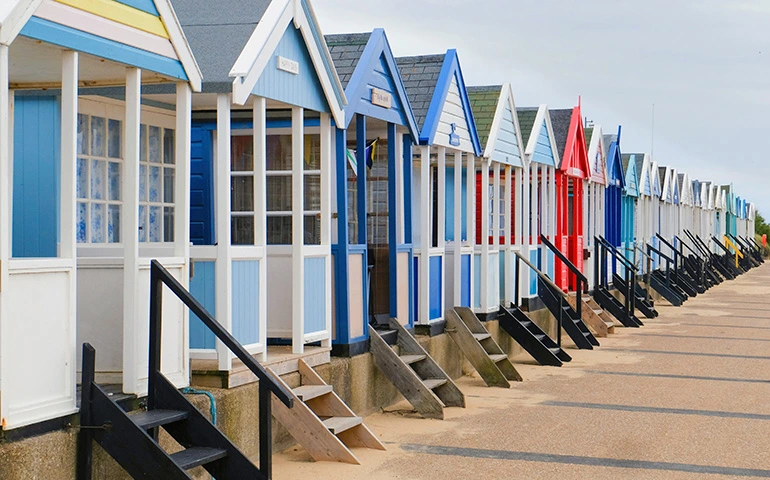
The brightly painted beach huts along Southwold’s promenade have become iconic. Rows of neat timber boxes facing the sea, each one slightly different in colour and personality. They began as simple storage shelters for bathing machines and seaside kit. Over time they evolved into symbols of a particular British seaside ideal. Ownership became aspirational.
That aspiration now comes with a serious price tag. Southwold beach huts regularly sell for figures that surprise first time visitors. Depending on location and condition, prices often sit between £100,000 and £200,000. Prime positions on the front row have exceeded that range in strong markets. For what is essentially a small timber structure without overnight accommodation, that seems extreme. The value is not in bricks and mortar. It is in scarcity, status and uninterrupted sea views in one of Suffolk’s most desirable coastal towns.
Locals tend to have mixed feelings. Some see them as part of the town’s character. Others see the prices as a sign of how far the property market has shifted. Either way, they remain part of the Southwold skyline and a major draw for photographers and day trippers.
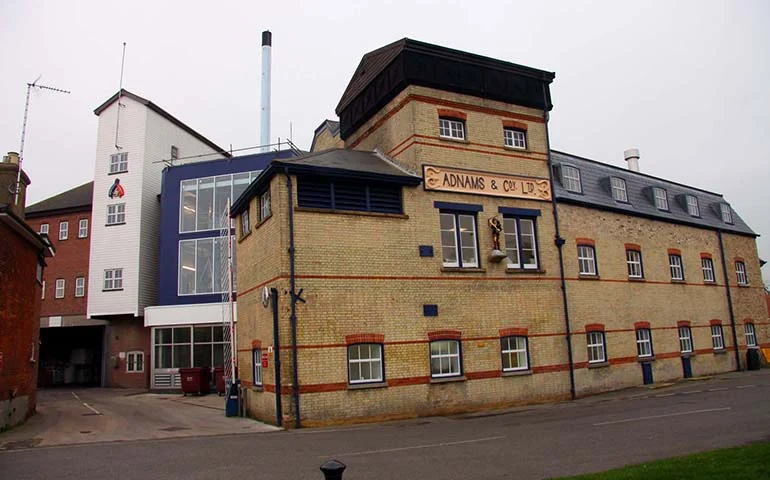
No account of Southwold is complete without mentioning Adnams Brewery. Brewing has taken place in the town since the 14th century, and Adnams in its current form dates back to 1872. The brewery sits at the heart of Southwold, not hidden on an industrial estate but embedded in the town itself. On certain days you can catch the faint scent of malt and hops drifting through the streets.
Adnams has grown into a nationally recognised name, producing beer and spirits while retaining a strong Suffolk identity. Its pubs across the county reinforce Southwold’s influence far beyond its size. Economically and culturally, the brewery anchors the town. It provides employment, draws visitors for tours and tastings, and ties Southwold to a broader network of coastal and rural communities.
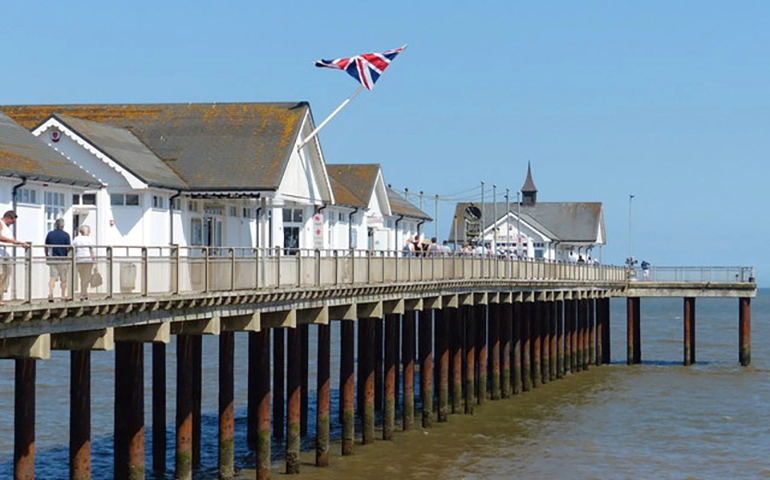
The Southwold Pier extends 190 metres into the North Sea and has become a focal point for visitors. The original Victorian pier was damaged and eventually dismantled in the 20th century. The current structure opened in 2001, designed to echo the past while offering modern attractions. It houses shops, cafés and the famously eccentric Under the Pier Show, a collection of hand built arcade machines that lean into humour rather than flashing lights.
Beyond the pier lies a sandy beach that shelves gently and is popular with families. The promenade runs parallel to the colourful huts, and further south the harbour area offers crabbing spots and views across to Walberswick. Practicalities are straightforward. Southwold is accessible by road, with parking at the common and near the seafront. In peak summer it becomes busy. Outside those months it can feel almost spacious.
Southwold matters locally because it balances tourism with identity. It has not turned entirely into a theme park version of itself. The lighthouse still works. The brewery still brews. Fishing boats still move in and out of the harbour. It carries its history without constantly advertising it. For Suffolk residents, it represents a coastal town that has managed to remain itself despite property pressures and seasonal crowds.
Spend a few hours here and you begin to see why people return year after year. It is the combination of open sky, understated architecture, solid pubs and that long line of painted huts staring out to sea. Southwold does not need to shout. It has the North Sea for that.

© 2026 Rum Owd Dew Made by WebDAC