
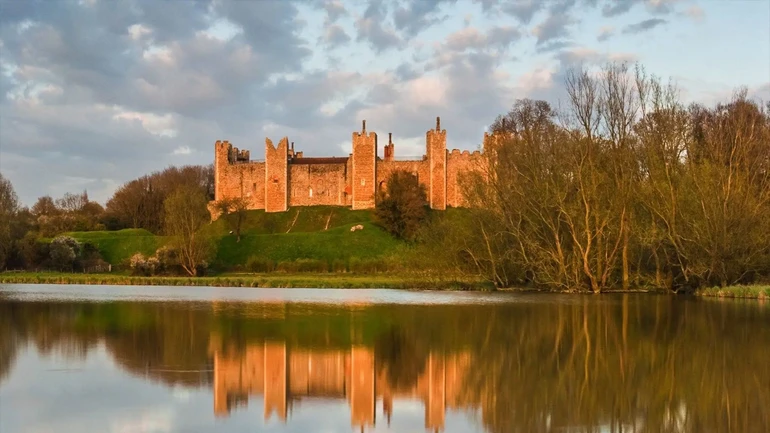
Standing proudly in the heart of the Suffolk countryside, Framlingham Castle is a magnificent relic of England’s medieval past. Built in the late 12th century by the powerful Bigod family, this imposing fortress has stood for over 800 years, witnessing the rise and fall of kings, political intrigue, and even playing a role in the story of Queen Mary I.
The castle’s most striking feature is its massive curtain wall, which remains remarkably intact. Thirteen towering battlements form a nearly circular enclosure, creating an imposing silhouette against the rural landscape. Unlike many castles of its time, Framlingham was not built with a central keep. Instead, its strength lay in these high stone walls, which provided formidable defence against attackers. Walking up to the site today, it is these walls that dominate the skyline, solid, unbroken and purposeful.
The Bigods, who were among the most powerful noble families in East Anglia, rebuilt the castle in stone after an earlier structure was destroyed. Their influence across Suffolk and Norfolk made Framlingham both a statement of power and a strategic stronghold. The castle controlled important routes through the region and acted as an administrative centre for the surrounding estates. It was not simply a military structure. It was a working hub of medieval life, with kitchens, halls, chapels and accommodation for retainers and servants inside the walls.
One of Framlingham’s most famous moments in history came in 1553 when it became a refuge for Mary Tudor. After the death of Edward VI, Mary’s claim to the English throne was challenged by supporters of Lady Jane Grey. Mary fled to Framlingham, where she rallied her supporters. From within these very walls, she gathered enough strength to secure her place as England’s first ruling queen. For Suffolk, this is not a distant national story. It happened here, in this market town, with local people forming part of the force that changed the course of English history.
Over the centuries, the castle’s role shifted. In the 17th century, it was used as a poorhouse, providing shelter for those in need. Later, parts of the site were adapted for other civic uses before eventually being preserved as a historic monument. These later chapters are easy to overlook, yet they reveal something important. Framlingham was never frozen in time. It evolved with the needs of the community around it.
There are details that many visitors miss. The absence of a central keep often surprises people who expect a tall tower at the heart of every medieval castle. The design at Framlingham reflects changing ideas about defence during the period, placing emphasis on a strong outer wall rather than a single fortified core. The wide grassy inner courtyard that you see today would once have been crowded with timber buildings and the noise of daily life. What feels open and peaceful now would have been busy and purposeful.
The castle’s location also adds to its character. The mere that sits alongside the walls creates a natural buffer and a striking reflection of the battlements in calm weather. It is easy to see why the setting continues to draw photographers, artists and walkers. The market town itself has grown around the castle, and its presence shapes the identity of Framlingham to this day. It is more than a backdrop. It is the town’s defining landmark.
For visitors today, the experience is straightforward and rewarding. The site is managed by English Heritage and is open to the public for most of the year. One of the highlights is the wall walk. Climbing the steps and making your way along the battlements gives wide views across open fields and rooftops, offering a clear sense of how dominant this position once was. Inside the walls, exhibitions help explain the castle’s development and the people connected to it. Displays focus on the Bigod family, the Tudor period and the later social history of the site.
Framlingham Castle works on different levels. For some, it is a key location in the story of Mary I. For others, it is a well preserved example of a medieval fortress without a traditional keep. Locally, it is part of everyday life, visible from roads, gardens and footpaths. School trips, family days out and quiet winter walks all happen within the same stone boundary.
Whether you are exploring its battlements, delving into Tudor history, or simply enjoying the scenery, Framlingham Castle stands as a testament to England’s past, a place where national events intersected with local lives. Solid, practical and still standing, it remains one of Suffolk’s most recognisable historic sites.

© 2026 Rum Owd Dew Made by WebDAC